
Project Overview
As a Mississippi native, I wanted to explore how design could address an issue affecting my home state: food insecurity. Transit Mississippi is a proposed transportation service connecting rural Delta communities to fresh, affordable groceries through accessible transit, retail partnerships, and a mobile platform. By examining the systems behind food access, I developed a solution that approaches transportation as an opportunity to improve community well-being.
Challenge
The challenge was to identify a complex systemic problem and propose a design-driven intervention that addressed its underlying causes rather than just its symptoms. I chose food insecurity in the Mississippi Delta, examining how limited transportation, geographic isolation, and economic barriers intersect. My goal was to develop a solution that could be desirable for residents, feasible to implement, and viable within the existing community infrastructure.
01 / Problem
The Problem & Opportunity
In the Mississippi Delta, access to fresh, affordable food is shaped by more than availability. Geographic isolation, limited public transportation, and economic barriers make routine grocery shopping difficult for many rural residents. Even when grocery stores exist, reaching them can be a challenge.
This revealed an opportunity to approach food insecurity through mobility rather than food distribution alone. By rethinking how communities connect to existing grocery retailers, transportation could become a tool for improving food access without requiring entirely new retail infrastructure.


02 / Research & Discovery
Research & Discovery
My research revealed how transportation barriers, economic hardship, and gaps in public assistance reinforce food insecurity in the Mississippi Delta. Limited mobility creates dependence on community food pantries, placing additional strain on resources that are already stretched thin.
Mississippi's decisions to opt out of certain federal nutrition initiatives highlighted another constraint: expanded government assistance could not be assumed. These findings shifted my focus toward opportunities within existing infrastructure, exploring how transportation and grocery retail networks could work together to improve food access without placing additional pressure on community resources.
03 / Design Process & Iteration
Design Process & Iteration
I began by developing Transit Mississippi as a public-private partnership concept connecting local transportation providers with major grocery retailers. To explore how residents might interact with the service, I created initial interface designs centered on route discovery, trip planning, and retailer offers.
Reviewing these early screens revealed opportunities to strengthen the experience beyond basic functionality. I refined the information hierarchy, developed a more cohesive visual identity, and expanded the user journey to include a digital boarding pass. The final designs introduced clearer route presentation, more engaging retailer offers, and an integrated E-ticket experience, transforming the initial concepts into a more complete and recognizable transit service.

04 / Solution
Final Solution
Transit Mississippi is a proposed transportation service designed to connect underserved communities with fresh, affordable groceries through a public-private partnership between local transit providers and major grocery retailers. By building on existing infrastructure, the concept creates an alternative pathway to food access while aiming to reduce pressure on community food pantries.
The accompanying mobile experience brings the service together through route discovery, trip planning, digital boarding passes, and exclusive retailer offers. Each feature is designed to make grocery trips easier to navigate, from finding transportation and preparing for a journey to accessing savings at participating stores.
A Closer Look at the Experience
Selected screens show how routes, trip preparation, boarding, and retailer offers work together in the proposed experience.

Routes
A focused view of route discovery and service details.
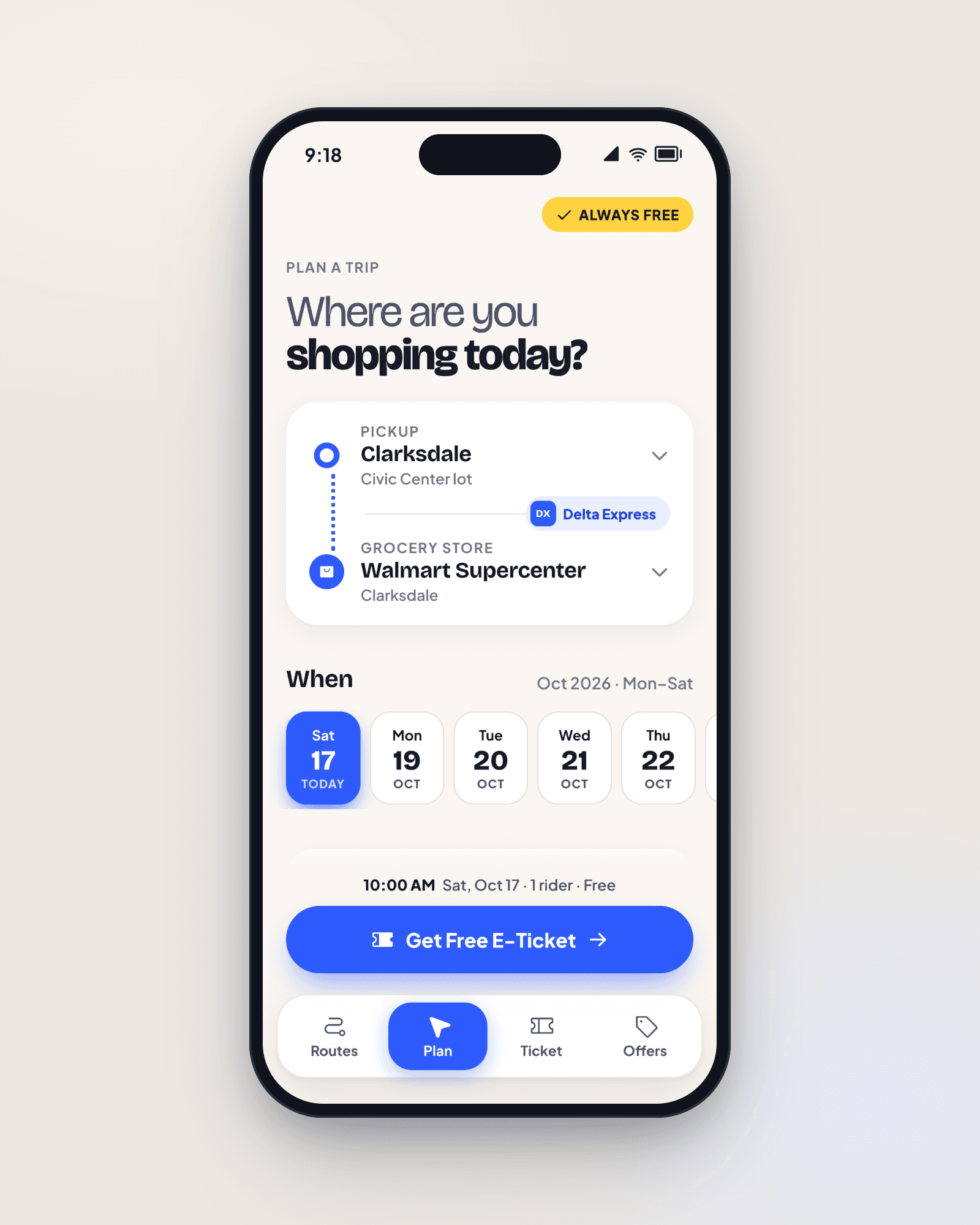
Trip planning
A clear planning flow for preparing a grocery trip.

Digital E-ticket and QR pass
A dedicated boarding moment that keeps trip details and confirmation easy to access.

Retailer offers
A closer look at the offer experience for participating grocery retailers.

05 / Value
Value, Viability & Trade-offs
Transit Mississippi was designed around a public-private partnership that could create value for multiple stakeholders. Residents would gain a more reliable way to access affordable groceries, while participating retailers could reach additional customers. By providing an alternative to emergency food assistance, the service could also reduce pressure on local food pantries. For government and transportation partners, the concept offers a potential way to improve access to essential services while supporting local economic activity.
However, implementation would depend on more than the strength of the concept. Limited transportation funding, the difficulty of establishing routes across rural communities, and potential resistance from government officials could challenge its feasibility. Smaller grocery businesses might also face increased competition from participating chains. These trade-offs highlight the importance of securing long-term partnerships, evaluating operating costs, and ensuring that expanded grocery access does not come at the expense of existing local businesses.
06/ Reflection
Reflection
Transit Mississippi challenged me to think beyond the interface and consider the larger systems that shape people’s everyday experiences. As someone from Mississippi, exploring food insecurity in my home state made this project particularly meaningful. I began by looking at access to affordable groceries, but quickly realized that transportation, economic barriers, and public policy were deeply interconnected.
One of my biggest takeaways was understanding that designing a solution doesn’t automatically make it feasible. Developing the public-private partnership concept pushed me to consider competing stakeholder interests, funding limitations, and potential political resistance. It also reinforced the importance of designing around existing infrastructure rather than assuming an entirely new system could be built from scratch.
If I were to continue developing Transit Mississippi, I would prioritize speaking with rural residents, transportation providers, food pantry organizers, and grocery retailers to validate the concept. I would also explore route feasibility, accessibility needs, and the long-term costs of operating the service.
Ultimately, this project expanded how I approach design. It taught me to see UX not just as the creation of intuitive digital experiences, but as a way to understand complex problems, question existing structures, and imagine more accessible systems.

